What Should Property Owners Know About Crane Safety Zones in Akron OH?
When a crane goes up on your property, the lift itself is just one piece of the puzzle. The area around it, what gets restricted, who can enter, and for how long, all of that gets sorted out before a single piece of equipment rolls onto your site. A lot of property owners don’t find out about safety zones until a crew is already staged and work has to stop. That’s not a good spot to be in.
Here’s the thing. Those delays cost money. And they happen more often than you’d think, just because no one walked through the zone requirements early enough. It’s kind of one of those things that feels like a small detail until it isn’t.
Working with a trusted crane rental company in Akron, OH, means someone on your team already knows this stuff. They’ve done the planning, they know what regulators look for, and they’re not figuring it out on the fly. That matters a lot when your project timeline is tight.
Getting familiar with how crane safety zones work before your project kicks off keeps things moving. It also keeps your property, your crew, and anyone nearby a whole lot safer.
What a Crane Safety Zone Actually Is
Not every property owner has had a crane operating on their property before, so it is worth being specific. A crane safety zone is the controlled area around an active crane during a lift, covering:
- The ground space beneath and around the load path
- The full swing radius of the boom
- Any area where a dropped load or unexpected equipment movement could cause harm
The exact dimensions depend on the crane type, the load being lifted, the boom angle, and how the site is laid out.
While the crane is active, the site restricts access to that zone. Pedestrians, vehicles, adjacent tenants, and, in some cases, neighboring properties must be factored into the plan before the lift date. If your site sits in a commercial corridor in Akron near active streets or neighboring structures, those details become more specific and more important.
How Safety Zones Get Established Before the Lift
This is where pre-job planning does its work. Before any lift begins, our team conducts the following steps on every engagement:
- Load analysis
- Site walkthrough
- Hazard identification review
These three steps determine where the crane gets positioned, how large the safety zone needs to be, and what obstacles or hazards have to be resolved before work starts.
The site walkthrough is where most of the safety zone information comes from. We check:
- Overhead clearances
- Access points
- Ground conditions
- Underground utilities that affect outrigger placement
- Whether adjacent areas can be controlled during the lift window
If there is a complication, we find it here, not on the morning the crane is staged and a schedule is running. That process is not optional. It is how every project we take on gets planned.
Overhead Utilities and Why They Come Up on Almost Every Akron Site
Overhead power lines are the most common factor that shapes crane safety zones on Akron jobs. Commercial roofing lifts, HVAC placements, and equipment installations frequently happen in areas where energized utility lines are close.
OSHA’s cranes and derricks standards require that crane operations maintain specific clearance distances from energized electrical lines, and those distances vary based on voltage level.
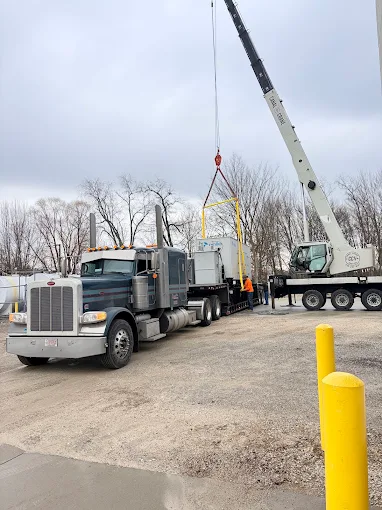
Our team identifies overhead utility locations during the site walkthrough and adjusts crane positioning before anything is staged. If a power line falls within the crane’s operating envelope, we coordinate the appropriate response before the lift date. Property owners who know where their utility lines run and can share that information early help the planning process move faster.
What Property Owners Are Responsible For
The crane contractor is responsible for establishing and enforcing the safety zone during the lift. But several things on the property owner’s side make the process go more smoothly.
Before our team arrives for the site walkthrough, it helps to have access to utility line locations, any subsurface information that affects where outriggers can be placed, and a clear picture of who will be on or near the property during the work window.
If your property has tenants, neighboring businesses, or shared access points, we need to account for them in the safety zone layout. Our team can advise on what to communicate, but notifying adjacent property users is the property owner’s responsibility.
Completing that step before the lift date prevents complications no one wants to deal with when a crane is already positioned and a crew is standing by.
Safety Zones on Different Project Types in Akron
The scope of a safety zone shifts based on what the crane is doing. A rooftop HVAC unit being set on a commercial building in Akron has a different safety zone footprint than a crane lift at an industrial facility in the Northeast Ohio corridor. The following factors vary depending on the project type:
- Vertical height
- Swing radius
- Pedestrian exposure
- Site access
Our work across Akron covers:
- Commercial roofing lifts
- HVAC equipment placements on multi-story buildings
- Structural steel picks for construction projects
- Industrial machinery installations at manufacturing and processing facilities
Each project gets its own site walkthrough and hazard identification before any plan is finalized. What works on one site does not carry over to another without that review.
How the Crane Fits Into a Larger Project Scope
A lot of property owners think of a crane as a single-service hire. Bring in the crane, do the lift, move on. On many Akron projects, the crane is part of a longer sequence. Equipment needs to be rigged before the lift. It may arrive on a flatbed and need to be offloaded first.
Once it is in position, a millwright crew handles installation and precision alignment. Structural connections may require welding to close out the job.
We handle all of that in-house under one contract. Crane operations, rigging, flatbed hauling, millwright services, and structural welding are all delivered by our team with no subcontractors.
That matters for safety zone coordination because every phase of the work is being planned by the same people. There is no handoff between separate companies that leads to missed assumptions on a site that was already walked and planned.
Frequently Asked Questions About Crane Safety Zones in Akron, OH
A crane safety zone is the controlled area surrounding an active crane during a lift. It includes the ground space beneath and around the load path, the boom’s full swing radius, and any area where a load shift or equipment movement could cause harm. Access to this zone is restricted while the crane is operating.
The crane contractor is responsible for determining and enforcing the safety zone. Our team establishes zone boundaries as part of the pre-job planning process (load analysis, site walkthrough, and hazard identification) before any equipment is staged on your property.
Crane operations near energized power lines must comply with OSHA requirements, which establish minimum clearance distances based on voltage. Our team identifies utility line locations during the site walkthrough and adjusts crane positioning before work begins.
Our site walkthrough checks overhead clearances, ground and access conditions, underground utilities that affect outrigger placement, and any adjacent areas that need to be controlled during the lift. This step happens before any equipment is staged and is standard on every project.
In most cases, yes. When a crane safety zone extends near adjacent properties or shared access points, those parties need to be informed before the work window. Our team can advise on what to communicate, but the notification itself is the property owner’s responsibility.
As early as your project schedule allows. Jobs with specific site constraints, utility proximity issues, or multi-service coordination benefit from planning lead time. Call (330) 227-8107 or visit canalcrane.com to start the process.
Yes. We handle crane operations, rigging, flatbed hauling, millwright installation, and structural welding under one contract. If your project requires more than a single lift, our team manages the full scope in-house with no subcontractors involved.
Get a Site Assessment for Your Akron Project
Call (330) 227-8107 or submit a request at canalcrane.com to schedule a project walkthrough. Our team reviews your site, addresses the safety zone requirements specific to your property and load, and coordinates the full lift plan before any equipment is staged.
Resources:
Related Topics: