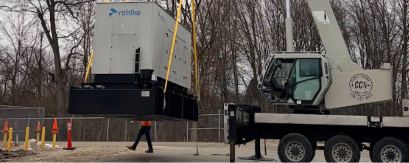
Do You Need a Crane Permit in Akron, OH?
A crane lift in Akron needs city approval when the crane, its outriggers, its counterweight swing, or its load occupies any part of the public right-of-way. A lift staged entirely on private property, inside your own fence line and clear of the sidewalk and street, generally does not. The city does not issue a permit called a crane permit. What it issues is right-of-way occupation approval, and that distinction catches contractors out regularly.
Our crew works this question into the walkthrough on every Akron job, because a permit discovered two days before a scheduled lift is a schedule problem and a permit discovered on lift morning is a canceled day. Fifteen years of mobile crane work on tight sites across Summit County has made that a standing item rather than an afterthought.
Where the Crane Sits Decides Whether You Need Approval
The boundary is the right-of-way line, not the property line, and those two are frequently not the same thing. In older Akron neighborhoods and industrial blocks, the public right-of-way often extends several feet past the sidewalk into what looks like private frontage. A crane set up on a driveway apron can be partially in the right-of-way without anyone on site realizing it.
Counterweight tail swing is the second trap. The machine can be fully on private property while its counterweight rotates over the sidewalk during the pick. That is occupation of the right-of-way for the duration of the swing, and it is treated as such. The same logic applies to a load that travels over public space between pick and set, even briefly, which is why we map safety zones around active lifts before anything stages. Our site walkthrough maps the full working envelope, including swing radius and load path, rather than just the footprint of the machine.
What Akron Requires Before Work Begins
The City of Akron handles right-of-way occupation through its Plans and Permits office under the Department of Public Service. The approval covers obstructing part or all of a street or sidewalk, and the ordinance behind it carries conditions beyond the application form itself.
Contractor registration with the city has to be current before an application is processed. The City of Akron is named as additionally insured on the policy covering the work. Where the occupation could affect the pavement or sidewalk surface, a restoration deposit is held against returning the surface to its original condition. Occupancy is charged against the square footage of right-of-way taken and the duration it is held, which is one reason a tight, well-planned crane position costs less than a sprawling one.
When a Lift Becomes a Street Closure
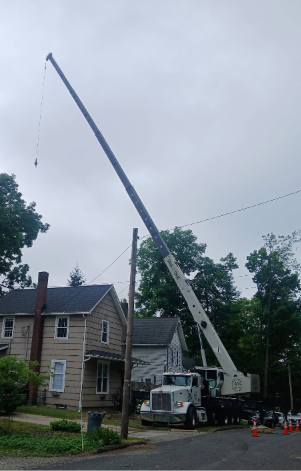
Some lifts cannot be executed without taking a travel lane or closing a street outright. A rooftop unit swap on a building fronting a narrow Akron street is a common example, and so is structural steel placement on a tight urban infill site where the crane has nowhere else to stand. Street-side picks like these call for a rigging company that plans the hitch around the lane window, because a short closure leaves no time to re-rig a load in traffic.
Closures are a separate conversation from simple occupancy and route through the city’s traffic engineering function, which reviews the proposed closure against traffic patterns, transit routes, and emergency access. Lead time matters here more than anywhere else in the process. A closure request submitted on short notice against a fixed production or construction date is the single most common reason a lift gets pushed. We build the closure question into the pre-job phase specifically so the application goes in while the schedule still has room to absorb a review. The same lead time applies when the load arrives by trailer, which is why our hauling service plans the truck’s staging spot alongside the crane position.
What a Right-of-Way Application Needs From Your Project
Applications stall on missing information far more often than on refusal. Having the package assembled before submission is what keeps a lift date intact.
An Akron right-of-way occupation submission for crane work typically calls for:
- Exact location and the square footage of right-of-way to be occupied
- Dates and hours of the occupation, including set-up and teardown
- A site drawing showing crane position, outrigger spread, swing radius, and load path
- Current contractor registration with the City of Akron
- Certificate of insurance naming the City as additionally insured
- Traffic control arrangements where a lane or sidewalk is affected
- Restoration deposit where the surface could be affected
The site drawing is where most of the engineering judgment lives. It has to reflect the crane actually being used, at the radius actually required, on ground that will actually carry the outrigger loads.
Not sure whether your lift triggers city approval? Give us a call at (330) 227-8107, and we’ll tell you on the walkthrough what the Akron application needs before your lift date is locked.
Call (330) 227-8107Why Permit Handling Belongs With the Crew Running the Lift
Permit coordination separated from lift planning produces a predictable failure. The permit gets filed against an assumed crane position, the crew arrives, the position does not work, and the approved footprint no longer matches the job. Amending it costs days.
We keep both in the same hands. The pre-job sequence we run on every engagement is load analysis, site walkthrough, hazard identification, and the permit position comes directly out of that walkthrough rather than being drawn from a sketch afterward. The same crew that confirmed the ground conditions and the swing radius is the crew that shows up to execute, which means the approved footprint and the working footprint are the same thing. That continuity is also why we handle rigging, flatbed hauling, millwright work, and structural welding in-house, and it is the same discipline described in our piece on crane position and jobsite footprint.
Permit rules change, fees get revised, and individual sites carry conditions nobody can read off a code book. Confirm current requirements with the City of Akron Plans and Permits office for your specific address before you commit to a lift date, and bring the crane contractor into that conversation early rather than after approval.
An Akron lift goes smoothly when the permit question is answered during planning. Call Canal Crane and Hauling at (330) 227-8107 or submit a request at canalcrane.com, and we’ll confirm whether your lift triggers right-of-way approval. We’re open 24 hours a day, 7 days a week.
Call (330) 227-8107Canal Crane and Hauling, LLC works across Akron, Canton, Youngstown, Warren, and Massillon from our Rootstown, Ohio base.
Related Topics: