Flatbed vs. Lowboy: Which Trailer Fits Your Load?
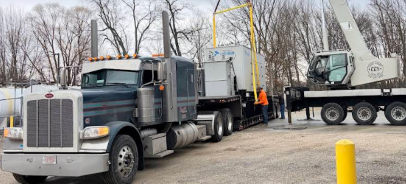
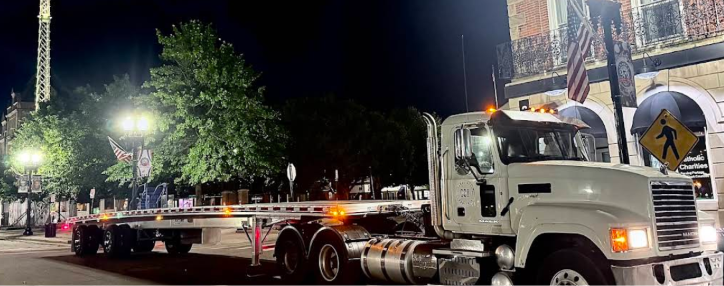
Load height decides it. A flatbed carries a deck around five feet off the ground and suits equipment, steel, and machinery that stays short enough to clear Ohio’s 13-foot-6-inch legal height from that deck. A lowboy drops its deck down between the gooseneck and the rear axles, often to around eighteen inches, and exists for loads tall enough or heavy enough that a flatbed would put them into permit territory or past it.
Weight and loading method follow close behind. We run both across the Northeast Ohio corridor and match the trailer to the machine during trailer selection and heavy transport planning rather than sending whatever is available. Two hundred completed hauling projects out of our Rootstown yard have made that call fairly quickly.
How Deck Height Decides the Answer
The arithmetic is unforgiving. Ohio allows 13 feet 6 inches from ground to the top of the load before a permit is required. Put a machine on a flatbed deck sitting roughly five feet up, and you have about eight and a half feet of load height to work with. Anything taller crosses the line.
A lowboy recovers most of that. Dropping the deck to around a foot and a half frees up close to twelve feet of load height within the same legal limit. Equipment that would have been an oversize permit on a flatbed often travels legal on a lowboy, which removes permit cost, permit lead time, and potential escort requirements from the move. For a plant in Canton shipping a tall press or a vessel, that single decision changes the schedule as much as the budget.
Weight Capacity and Axle Configuration
Height is one filter. Weight is the other, and the two do not always point at the same trailer. A standard flatbed is built around legal gross weight limits, which puts practical cargo capacity in a range that handles most steel and mid-sized machinery without a permit.
Lowboys are built heavier and can be configured with additional axles to spread load across more contact points. That matters because Ohio enforces axle loadings and spacing alongside gross weight, so a heavy machine that would overload a flatbed’s axle group can sometimes travel legally on a properly configured lowboy. Our crew works the axle math during load analysis, the same way we approach heavy machinery lift planning, because discovering an axle problem at a scale is considerably more expensive than discovering it in the yard.
How the Load Gets On and Off
Loading method separates the two trailers as clearly as deck height does. A flatbed is open on every side, which makes it straightforward for a crane to set a load from above or a forklift to place one from the side. For steel, pipe, crated equipment, and anything with clean lifting points, that open access speeds up both ends of the trip.
Lowboys usually carry a detachable gooseneck. The front section disconnects, the deck drops to the ground, and tracked or wheeled equipment drives straight on. For an excavator or a piece of plant with its own mobility, that eliminates the lift entirely. For a machine with no drive capability, the recessed well actually complicates crane access slightly, since the deck sides restrict how the rigging can approach. That is worth working out before the crane is booked, not after, and it feeds directly into securing loads for transport once the machine is positioned.
Where Each Trailer Earns Its Place on Ohio Jobs
Flatbeds carry the volume. Structural steel to a Warren construction site, palletized equipment into a Massillon plant, fabricated components, shorter machinery- anything that loads cleanly and travels legal. Lower cost, faster turnaround, simpler permitting because most of it does not need permitting at all.
Not sure which trailer your load actually needs? Give us a call at (330) 227-8107, and we’ll size the move from your dimensions and weight before the machine is ever loaded.
Call (330) 227-8107Why the Trailer Decision Starts With the Lift
Trailer selection made in isolation from the lift is how equipment gets damaged. The crane has to be able to reach the load where it sits on the deck, at a radius that preserves capacity, with rigging that can approach the attachment points without fouling the trailer structure.
Our pre-job sequence runs the same on every engagement: load analysis, site walkthrough, hazard identification. Load analysis establishes weight, dimensions, and center of gravity, which is what sizes the trailer and the crane together. The walkthrough covers both ends of the move, including whether a detachable gooseneck has the room it needs to drop and reconnect. Hazard identification covers what has to be cleared before any of it happens. Because our crew carries flatbed hauling, crane operations, rigging, millwright installation, and structural welding on one contract, the trailer decision, the lift, and the installation are made by people who all have to live with the consequences of getting it wrong.
Trailer choice is a ten-minute conversation once somebody has the dimensions and the weight in front of them, and it is a great deal more expensive to revisit after a machine is already loaded.
Trailer choice is a ten-minute conversation once the dimensions and weight are in front of us. Call Canal Crane and Hauling at (330) 227-8107 or submit a request at canalcrane.com with your dimensions and weight, and we’ll size the move. We’re open 24 hours a day, 7 days a week.
Call (330) 227-8107Canal Crane and Hauling, LLC provides hauling services in Akron, OH and hauls heavy equipment across Canton, Youngstown, Warren, and Massillon from our base in Rootstown, Ohio.
Related Topics: