Who Handles Rigging on an Akron Crane Lift?
Rigging on a crane lift is the responsibility of the rigging crew, working from a rigging plan developed before the machine arrives. The crane operator runs the machine. The riggers attach the load, set the configuration, calculate sling angles, and signal the pick. On many Akron projects, those two functions sit with two different companies, and the gap between them is where loads get damaged, and schedules slip.
On these jobs, both sit with one crew. Experienced rigging plan development and load securing is delivered in-house alongside the crane, which means the people who worked out how the load comes off the ground are standing next to the operator when it does. More than 50 rigging engagements across Northeast Ohio have run that way.
What the Rigging Crew Owns on a Lift
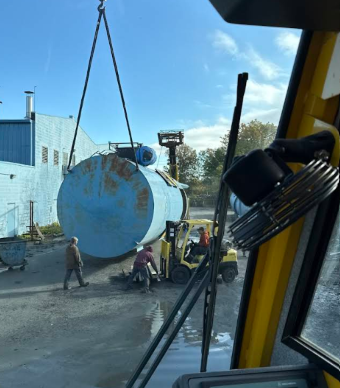
Riggers establish how the load connects to the hook and how it behaves once it leaves the ground. That starts with the center of gravity, because a load picked off-center will rotate the moment it lifts clear, and it ends with the landing orientation, because a machine that arrives rotated ninety degrees from its anchor bolt pattern has to be set down and re-picked.
Between those two points sits the hardware decision. Slings, shackles, spreader bars, below-the-hook devices, softeners at every contact edge, and the angle each sling runs at. Sling angle is the detail that catches people who have not done the math: the tension in a sling climbs sharply as the angle flattens away from vertical, so a two-leg configuration at a shallow angle can load each leg well beyond the load’s actual weight. That calculation belongs to the riggers and gets documented before anyone touches the hardware.
What the Crane Operator Owns
The operator owns the machine and the pick itself. Set-up position, outrigger deployment and matting, boom configuration, load chart compliance at the working radius, and the controlled execution of the lift and swing. The operator also owns the refusal, which is one of several reasons experience behind safe picks carries real weight on an industrial site. A certified operator who reads the load chart and sees the pick outside capacity stops the job, and that authority is not negotiable regardless of who is on site asking.
What the operator does not own is the rigging configuration. The division exists for a reason. Two sets of eyes on a load, each responsible for a different half of the problem, catch errors that one person working alone will miss. Our crews maintain that division internally while removing the contractual gap between the two roles, which is the part that creates trouble when rigging is subcontracted out.
What Goes Into a Rigging Plan Before the Crane Arrives
A rigging plan is a document, not a conversation on the tailgate. It is produced during the pre-job phase, and it is what the crew executes against on lift day.
A rigging plan for an industrial lift in Akron, Canton, or Massillon typically documents:
- Confirmed load weight, dimensions, and center of gravity
- Attachment points and their rated capacity
- Sling type, size, configuration and working angles
- Shackles, spreader bars and below-the-hook equipment by rating
- Crane position, working radius and capacity available at that radius
- Load path from pick point to set point, including obstructions
- Exclusion zones and the signaling arrangement for the crew
Confirmed is the operative word on the first line. Weight taken off a nameplate that has been modified, or off a drawing that no longer matches the machine, is the most common bad input in the whole document. Our crew verifies figures during load analysis rather than inheriting them. When the machine also needs moving, those same verified figures size the trailer for our equipment haulers, so the load is measured once and trusted at every step.
Want the rigging plan and the crane to come from the same crew? Give us a call at (330) 227-8107, and we’ll walk your site and build the plan before lift day.
Call (330) 227-8107Why Splitting Rigging From the Crane Costs Money
The handoff failure follows a pattern. A crane company quotes the lift and arrives expecting rigging to be handled. A rigging outfit quotes the rigging and arrives expecting the crane position to suit their configuration. Neither assumption was written down anywhere, and both crews are on the clock while it gets resolved in the yard.
When it goes wrong in a more expensive way, the load lands out of position or sustains damage, and the two companies disagree about cause. The crane contractor points at the rigging configuration. The rigging contractor points at the set-up position or the swing. The plant manager who hired both pays for the remobilization while that argument runs. Removing the second contract removes the argument. Riggers, certified crane operators, and lift execution come from the same crew, under one scope, and a problem on site gets solved on site.
How Our Crew Sequences Rigging on an Akron Job
Every engagement our riggers in Akron, OH take on starts the same way regardless of size: load analysis, site walkthrough, hazard identification. Load analysis produces the weight, dimensions, center of gravity, and attachment points the rigging plan is built on. The walkthrough establishes crane position, load path, and the ground conditions underneath both. Hazard identification documents what has to be cleared, de-energized, or isolated before work begins.
The rigging plan is drawn from those three steps rather than developed in parallel by someone who never saw the site. On lift day, the crew runs a pre-lift briefing against that plan, rigs the load, performs a test lift to confirm the load behaves as calculated, and proceeds only once it does. For projects where the equipment also needs transporting, setting, and welding, the same crew carries flatbed hauling, millwright installation, and structural welding through to completion, so the load never changes hands between companies. That continuity starts well before lift day, and it runs through the pre-lift safety meetings our crews hold on site.
Rigging and crane work belong together. Call Canal Crane and Hauling at (330) 227-8107 or submit a request at canalcrane.com, and our crew will walk your site, build the rigging plan, and run the lift. We’re open 24 hours a day, 7 days a week.
Call (330) 227-8107Canal Crane and Hauling, LLC serves the Northeast Ohio industrial corridor from Rootstown, Ohio.
Related Topics: