Why Is Operator Experience Important for Crane Projects in Akron, OH?
Certification tells you an operator has met the minimum requirements to run a crane. Experience is what happens after the test, in the years of actual picks, across the variety of loads and sites and conditions that no exam can fully prepare you for. The difference between the two shows up in the moments that do not follow the script.
The load is balanced differently than expected. The ground that shifts under an outrigger during a long lift. The placement zone where the site and the plan are just… at odds with each other. You know, those are the moments that separate a credentialed operator from a seasoned one.
In Northeast Ohio’s industrial and construction market, that difference plays out on real projects in Akron, Canton, Youngstown, and Warren. As an expert crane rental company, Canal Crane and Hauling brings both to every job: the documented qualifications and the field-built judgment that those qualifications do not quite measure. That combination matters more than most clients expect, and here is why.
What a Crane Operator Manages During a Lift
A crane operator is not sitting in the cab waiting for instructions. From the moment the hook engages the rigging, they are:
- Reading the load and checking for level
- Watching for any sign that the rigging is loading unevenly
- Sensing through the machine any resistance or drift that suggests something is not configured the way the plan said it would be
That awareness is not instinct. It comes from having made enough picks to know what normal feels like and to notice when it does not.
Beyond the physical operation, an experienced operator is also tracking the load’s relationship to every obstruction in its path: rigging clearance over a wall edge, the swing arc relative to overhead utilities or adjacent structures, the gap between the end of the load and the opening it has to pass through.
Managing all of that simultaneously, in real time, is not something experience makes easier. It is something experience makes reliable. Our services and solutions are built around a crew that brings this level of attention to every engagement, not just the ones that look complicated on paper.
Reading a Job Site Before the First Pick
Experienced operators do not wait for the pre-job briefing to start forming a picture of the site. They walk the ground before they park the crane. They look at:
- Soil condition where the outrigger mats will sit
- Any slope or drainage patterns that affect stability
- Surface features that might indicate underground structures or utilities under the planned outrigger positions
- The swing path from a physical standpoint, not just how it reads on a drawing
That site-reading ability is part of why the pre-job planning process, load analysis, site walkthrough, and hazard identification matter more, not less, when the operator doing the walkthrough has done this work for years.
They catch things that do not show up on drawings: a ramp edge that looks stable but will not carry outrigger loads at the planned working radius and a clearance measurement that looks adequate on paper but does not account for the actual tip behavior of the load at the end of the boom.
OSHA crane safety standards governing this work call for exactly this kind of pre-lift site assessment. At Canal Crane and Hauling, we run that assessment as standard operating procedure, and the operator is part of it.
Load Control, Rigging Awareness, and Real-Time Decisions
Some of the most consequential decisions on a crane lift happen after the pick begins. Load shift when the hook first engages, a rigging point loading at a steeper angle than the plan assumed, and a swing that meets unexpected resistance halfway to the set point. Each of these calls for an immediate response. What that response is depends entirely on how much the operator has encountered before.
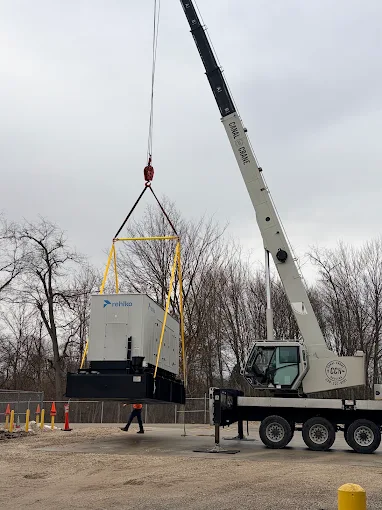
An experienced operator has a library of situations to draw from. They know:
- The difference between rigging that is working as designed and rigging that is about to introduce a problem
- How a load behaves when the center of gravity is forward versus aft
- How much correction is available before a controlled adjustment becomes a reactive one
On a precision pick at an Akron industrial facility, whether it’s a tight equipment placement, a structural steel set with a narrow bearing window, or a multi-point lift on an asymmetric piece of machinery, those adjustments are what separate a clean pick from a corrective sequence that costs time and creates exposure.
How Operator Experience Affects Project Timelines
A lift that has to be aborted and reset costs time. A load that misses its set point costs time, and sometimes equipment damage alongside it. Repositioning the crane because the initial setup was marginal costs time, and it holds up every trade on-site that was waiting for the lift to finish. Most of these delays trace back to decisions that were made, or should have been made, before the crane hook left the ground.
Experienced operators run tighter cycles. They position the crane correctly the first time because they have learned what correct setup looks like from doing it wrong, figuring out why, and not doing it wrong again. They have read enough rigging configurations to spot a problem during the pre-lift check rather than mid-pick.
On a project with multiple picks in a day, a truss crane set, a structural steel sequence, and equipment placement before the millwright crew needs access, that efficiency compounds. One hour saved per lift across a five-day framing project is not a small number. The Canal Crane gallery reflects the kind of work, millwright services, and project complexity that builds this kind of experience.
Experience Across a Multi-Service Industrial Crew
Crane operator experience matters more, not less, when the crane is part of a larger multi-service project. On jobs that also involve rigging, hauling services, flatbed hauling, millwright installation, or structural welding, the operator is working in coordination with the rest of the crew.
The placement of the load has to be right not just for the lift itself but for what comes next: the millwright alignment, the structural weld connection, and the base preparation under the equipment.
Our operators work alongside the same rigging team, the same millwright crew, and the same welders on every project. They know the tolerance on machinery installation. They know where the welding crew needs clearance to make the connection after the crane sets the load. They know how the millwright needs the equipment oriented before it touches the base.
That internal coordination is something that develops over time between people who have worked together, and it is what makes single-vendor execution across all five services function in practice, not just in a project description.
That is the version of experience that matters most to plant managers in Akron running tight production windows and GCs in Summit County managing compressed schedules. It is also what is behind the numbers:
- 100+ crane services completed
- 200+ flatbed hauling projects completed
- 50+ rigging solutions completed
- 30+ welding jobs completed
All across the Northeast Ohio industrial corridor, by a crew that stays together from pre-job planning through final weld.
Related Topics: